
The most seductive new idea in cancer medicine is the blood test that claims to spot cancer early — sometimes before any tumour is visible. The promise is real, and the science is genuinely interesting. The proof is not yet where the marketing is.
The largest study of a multi-cancer blood test — a randomised trial of over 140,000 people in the UK, presented at ASCO 2026 — did not meet its main goal of reducing late-stage disease. It found more cancers. Finding more cancers is not the same as helping people live longer, and the meeting said so directly: a test that simply increases what we detect should not be judged a success on that basis alone.
Then there is the cost of a wrong alarm. In one modelled population, screening 100,000 healthy people produced around 900 positive results — of which roughly 340 were real cancers, and over 550 were false alarms. Some of those 550 went on to invasive tests for a cancer they never had. And for many of the cancers these tests flag, there is no established next step — no proven scan, no guideline pathway.
You are handed a worry without a map.
This is the report I see most often in clinic now — a multi-cancer blood test, a polygenic risk score from a saliva kit, an HRc result ordered after a relative's diagnosis abroad. The packaging changes. The question I am asked does not: "Doctor, it says I'm high risk. What do I do?"
So let me start where I start with them.
A higher risk is not a diagnosis. It is a probability. Being told you are above average does not mean you are headed for cancer. On any bell curve, someone is always above the middle. That is what an average means. A number that places you a little to the right of most people is not a sentence — it is a statistic looking for context. We are wired to read a percentage as a prophecy. It is not one.
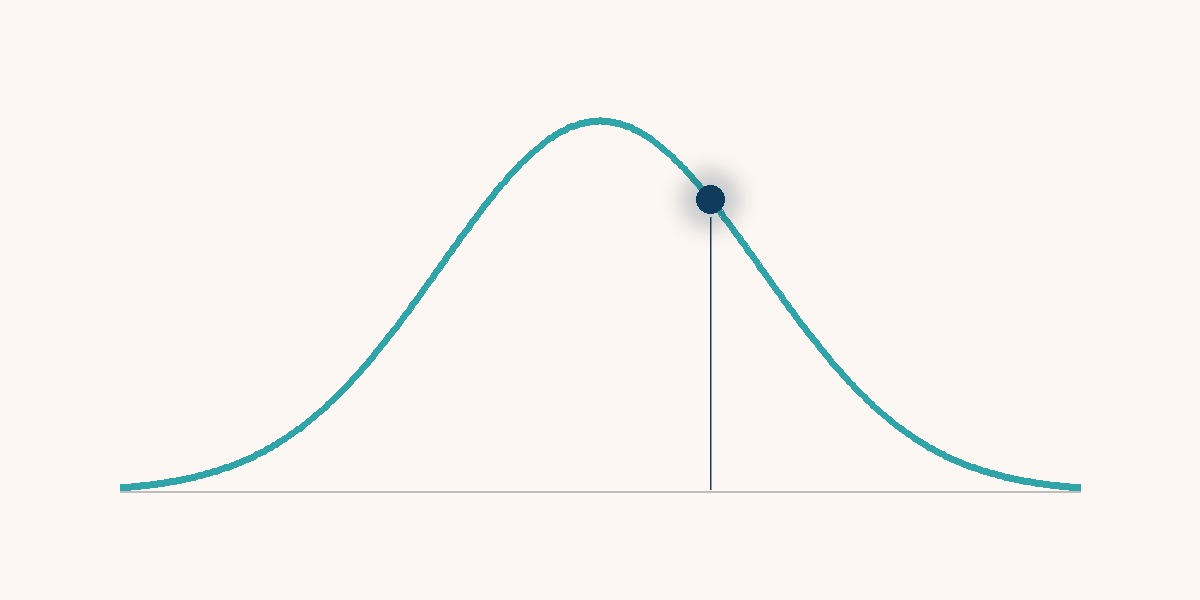
Most of the confusion I see comes from blurring two very different things. So let me separate them.
Screening and risk prediction are not the same question
Screening asks one question: is there a cancer here, now, that we can catch early? That is what a mammogram, a Pap smear, a low-dose CT for a heavy smoker, or a colonoscopy is for. These tests sit inside guidelines built over decades — guidelines that already split people into average-risk and high-risk groups, and that we adapt for Indian patients, because our cancers, our ages, and our resources are not identical to the West.
Risk prediction asks a different question: what are the odds this person develops a cancer someday? The newer reports — the ones built on the tiny common spelling differences in our DNA — are doing the second thing while patients hear the first. They estimate a chance. They do not find a cancer.
Reading a risk estimate as if it were a screening result is the single most common error I untangle across my desk.
"It mentions BRCA" — but which BRCA?
This one deserves its own paragraph, because the word does real damage.
A polygenic report that flags a slightly raised "BRCA-related risk" is not the same as a proper germline test for hereditary breast and ovarian cancer syndrome. They share a name and almost nothing else.
Germline testing looks for a specific, inherited, disease-causing fault in BRCA1 or BRCA2 — the kind that genuinely changes what we recommend for you and for your blood relatives. A risk score, built from dozens of common variants, is a population-level nudge, not a personal verdict.
Even within true germline testing, not every result carries the same weight. ASCO's 2026 prevention faculty was blunt about this: clearly harmful BRCA1, BRCA2 and PALB2 faults drive real action, while moderate-risk genes do not — and some BRCA variants raise risk by less than the family lore has come to assume.
So when a consumer report drops the letters BRCA into a paragraph, the honest answer is not panic. It is: this needs the right test, read by the right person, before it means anything at all.
The oldest rule in medicine still holds
There is a principle I was taught early and have never had reason to abandon: do not order a test if you do not know what you will do with the result.
A test can be accurate and still be unhelpful.
ASCO's 2026 faculty made this concrete for circulating tumour DNA testing in early breast cancer — sold under brand names like Signatera and Guardant Reveal, and increasingly ordered after surgery to look for microscopic disease left behind. The test is strongly prognostic — a positive result tells us something is there. But it is not yet clinically actionable. It is endorsed neither by ASCO nor by the major guidelines, despite being widely available and increasingly marketed in Indian metros.
The harms are quietly real. A positive result buys anxiety, and sometimes pushes people toward costly, toxic, unproven treatment. A negative result buys false reassurance, and sometimes pulls people off treatment that was working. A result you cannot act on is rarely a neutral result. More often, it is a new problem.
So what is a risk report good for?
Here is the part worth keeping. A report telling you that you carry more risk than average is a genuine, useful prompt to do the boring things that actually move the needle.
Most of the reduction in cancer deaths over the past fifty years has come from prevention and early-stage control — not from rescue at the end. Stopping tobacco. Treating obesity. Moving your body. Cutting back on alcohol. Vaccinating against HPV and hepatitis B. Showing up for the standard, guideline-based screening that applies to you.
That is where a risk score earns its place — as a reason to change habits, not as a reason to live in the scanner.
Whether you also need more frequent screening than the guidelines suggest is a separate decision. It is not made by a report. It is made by a clinician who knows you, your family history, and what the evidence actually supports — together, in conversation.
The sequence most patients get wrong
I understand the fear underneath all of this — the patient's, and sometimes the doctor's. When someone has spent good money and arrives frightened, the easiest path is to order more tests, just in case.
But the sequence is what most patients get wrong. Someone arrives with an HRc test result and tells me they have never had a basic screening colonoscopy. The next brings a polygenic risk score from a saliva kit, having never had a consult about whether they qualified for proper high-risk testing in the first place. The fancy test is being done before the standard one, and the conversation that should have happened first — am I in this testing pathway at all, and why — has been skipped entirely.
A number on a report is the start of a conversation — not the end of one.